Monday, July 25, 2011

From Poet Laureate to green technology advocate, and so much more --- Meet the Incomparable Ronnie Holland

Having lunch with Ronnie is a gift.  Not just because she’s such a great conversationalist, but because the woman is simply mind bending.  There’s no other better term.  Some of us are right brained, some left, but Ronnie is right, left, top, bottom and all around.    So when she became Poet Laureate for Dublin, I guess I shouldn’t have been surprised --- I mean what else was there left for her to do, really?  Well, I need to be careful what I say, because there’s so much more she’ll adventure into, and I can’t wait to see where she goes. 

Meanwhile, I hope you have fun learning a bit more about Ronnie.  I suggest a glass of wine, a comfy chair and an open mind.  Here we go!


 The incredible Ronnie Holland!

Ronnie, I met you and your husband, Michael, many years ago when you were working with my husband, John, at Qantel.  It was an amazing time in the evolution of technology.  How did you happen to be there at that particular moment, and what was your focus and specialization?


Michael and I had just gotten married that year, and I wanted to shift from my variable hours in the hospitality field as a Bay Area tour guide for California conventions to something closer, and in the high tech field. I started as a technical assistant organizing the programming department’s source tapes to maintaining the department capital asset inventory, co-coordinating our department’s test and office layout during the move to a new facility; then I became software systems coordinator (produced software release masters, coordinated company offsite backups, helped keep seven test computers running by ordering or borrowing replacement equipment and working with field service); and finally, manager of a new Qantel Information Center – from concept, layout, budget, publications, database searches, monthly information bulletins, a proposal for computer security and disaster planning, and a presentation skills package. John used to come into the Information Center most afternoons to keep up with developments, so that’s how I got to know him. Many long term friendships were forged at Qantel, including my former office mate; we moved to the same street and have been neighbors for over 20 years!

You’ve had and continue to have a remarkable career, Ronnie.  Before we get to your latest endeavors, please trace your career after Qantel, including the birth of your own company with your husband, Michael, Renaissance Resources.  


Ha, that’s how I got to know you! I started Renaissance Resources (RR) after I left Qantel to accommodate our many interests, with a business name that could evolve with us.  My earliest activities included writing and publishing my own newsletter; business development as an outside sales consultant for a travel agency; preparing sections of financial plans for the company you worked for at the time, and organizing their software files into boilerplates, plus the always fun role of facilitating one of their retreats. RR includes Michael’s IT & Networking side of the business, and my consulting work.


   Ronnie and Michael in Tahoe.

At one time I know you worked with the U.S. Olympic Team as a massage therapist.   When did you embark upon that role, and what made you decide to pursue that unique path?  I think you weigh about 100 pounds and are about five feet tall.  How in the heck did you decide to become a massage therapist in the first place?

To go back to the earliest beginning, my parents knew a wonderful Swedish lady who was our babysitter early in our lives (my two sisters and I).  She used to wake us from our naps by massaging our faces while we pretended to be asleep so she wouldn’t stop! We always awoke from naps with a smile! Later, I heard my mom say often: “If I’m ever rich, the first person I will hire is a massage therapist!” The first time I met Michael was during a party for his college Spanish class, and I volunteered to work on his sore shoulder.

I figured I’d better learn all about it, so I went for the works at the National Holistic Institute in Berkeley/Emeryville: obtained my basic 100 hour certification, then 500 hours (just in case requirements changed later, which they did); then their 1000 hour program, graduating with a Holistic Health Educator and Massage Therapist certificate. In parallel I’ve been a Professional Member of the American Massage Therapy Association (AMTA) since 1985, pursuing their certifications by becoming a Member of the AMTA National Sports Massage Team in 1988, and passing dual exams to be certified as a Registered Massage Therapist (RMT) and Sports Massage Therapist (SMT) while acting as a Bay Area Delegate to First International AMTA Convention, Toronto (August 1989).  I was also asked to chair the local AMTA chapter’s sports massage program, and with two colleagues formed the Bay Area Sports Massage team. With monthly reports, research on needs of sports from fencing to football (and everything in between!), continuing education, setting skill levels, preparing proposal and documenting events, we grew the team from 4 to 72 members in two years. It was fabulous learning so much about different sports, troubleshooting and helping with pain and recovery. We provided sports massage as a way of educating the public about professional massage at 16 events the first year, (e.g., the San Francisco Zoo Run, Dance for Heart, the Pacific Coast Fencing Championships, Bay to Breakers, the Tevis 100 mile Endurance Cup (Horse) Ride, and the World Corporate Games). I did not travel with the US Olympic Team, but several of us worked on them for several years during their training in Burlingame prior to the Seoul Olympics, and I worked as a National Sports Massage Therapist at the Goodwill Games held in Seattle. I was on the faculty for two years at the National Holistic Institute, and organized and wrote about a research project (published by the Massage Therapy Journal) tracking energy changes during massage using infrared photography, as well as other articles and presentations.

I consider massage therapy a lifetime skill, as I learned with my aging parents, that touch is the last sense to go, and a wonderful way to maintain contact during someone’s final days. Size and weight are not as important as therapeutic intention, leverage, excellent body mechanics and energy. It gives me a good balance in my High Tech/High Touch world.

Tell us about your latest, incredibly timely and fascinating professional venture in energy research, affiliated with UC Davis.  How did your involvement with this unique effort come about?

As you know, Michael and I always look for humor, creativity and integrity in the folks we work with (especially finance and taxes!). I‘ve been blessed to work with several outstanding teams during my career to date. The foundation for what I’m doing now began during the eleven years I worked in PG&E’s Research and Development Department – a dynamic time when the utility industry was shifting from a monopoly to deregulation. I was fortunate to be part of the team working on all the new alternative and renewable energy sources (and later, in energy delivery and control). These were people who continued to push research and policy in private industry or government after PG&E disbanded their world-renowned Research Department. After PG&E, I did consulting work for two research collaboratives (advanced gas turbines; solar photovoltaics) before shifting gears back to the High Tech field. This time I was responsible for all outbound communications for an innovative team of network analysis and troubleshooting software developers – the products used by those managing network security or acting as expert witnesses in prosecuting computer hackers.

When I left the network analysis firm, the former director of our PG&E renewable energy team contacted me about new efforts he was pursuing at UC Davis for California’s renewable energy future goals. My recent communications experience and pace of business in private industry was essential for our new team’s work in developing tools, events and content to coordinate and integrate research done, planned or needed for effective deployment of technologies at the building, community or utility scale. We were able to quickly launch our website http://cal-ires.ucdavis.edu/, even without the web designer and I meeting in person until after launch! Interest in renewable energy integration and deployment continues to grow as California and the U.S. race to meet aggressive energy and climate goals.

So, as with many of you who are extremely technologically savvy, you have this amazing creative side as well.   In fact, you are especially well known in your community as Dublin’s first Poet Laureate, serving a two year community volunteer position from May 2008 to May 2010.  How did that come to be?  What does a Poet Laureate do?

I happened to notice the City of Dublin’s “Call for Poet Laureate,” and realized I met their requirements.  We were about to leave for our 30th Wedding Anniversary trip to Europe, so I quickly sent off my letter of interest, and upon return from our trip, learned that I had been selected to be Dublin’s first poet laureate!

The position of poet laureate is an honorary title, originating from the ancient Greeks' practice of crowning their artists and athletes with laurels. Poet laureate programs vary by locale, with poets serving a tradition of advancing the knowledge and enjoyment of literary arts through public readings, education, and community events.  The position of poet laureate began in the middle ages in England, when Ben Jonson received that honor in 1616. Remarkably, California had the first poet laureate in the United States, honoring Ina Donna Coolbrith in 1915 through 1928. http://en.wikipedia.org/wiki/Poet_Laureate_Consultant_in_Poetry_to_the_Library_of_Congress. Currently, 40 states have state poets laureate.  California, and the greater Bay Area in particular, has had rapidly growing laureate programs. The nine-county area has more than half of the state's local (county, district, or city) poets laureate. For photographs of current and past poets laureate in your area, see http://www.poetslaureate.com 

As Dublin’s first poet laureate, I served as a public advocate for the appreciation and advancement of the literary arts by writing original poetry for civic events, doing program and web site content development http://www.ci.dublin.ca.us/index.aspx?NID=276, hosting poetry readings, and collaborating with other poet laureates, literary groups, schools and writers of all ages and experience. During my term, I wrote “poems of place” for Dublin park and community center dedications, Hope Hospice annual events, and read and judged poetry for school events. It’s been great fun being part of the lively poetic tribe!


 Ronnie Holland, Dublin, California’s First Poet Laureate.

I began writing poetry in high school, and then pursued a degree in English from California State University Hayward/East Bay, which included studies with visiting professors Mark Strand (U.S. Poet Laureate 1990-1991) and Timothy Steele.  I draw inspiration from folklore, mythology, the environment, relationships and travels. I’ve been published in anthologies including the 2011 Las Positas College Anthology, Illuminating Echoes, the (first) 2009 California Poets Laureate Anthology Sometimes in the Open, Best Poets of the 20th Century on Man & Environment 1975, and Peopled Parables.


 Ronnie reading at Old St. Raymond’s Church.

With all that you have going on, it’s amazing to me that you have recently published a book of poems, illustrated beautifully.  Tell us about the evolution of the book, Ronnie.  What is the title?  How did you and the artist meet and come together on this lovely creation?

I collaborated with artist Lily Xu for a December 2010 chapbook entitled Where a Painter Meets a Poet, containing 19 poems and paintings.


 Ronnie’s first poetry book, done in collaboration with Lily Xu.

We met at an art, poetry and wellness event in 2009.  I was intrigued by Lily’s remarkable range of artistic styles, and we both realized a commonality of themes.  Initially, we collaborated in several Ekphrasis (poetry written about another art form) events, which led to this book.  Lily sent me her paintings without titles; then like a blind date, the chemistry with a particular piece was realized in an existing or newly created poem.  Usually, poets write to a painting.  For our book, I told Lily the story behind “Stars” and challenged her to paint to the poem, so she created a new watercolor. The third aspect of the collaboration was the publisher, http://www.customsportscards.com/. Dave Farpelha’s selection of the background and border emphasis from each watercolor enhanced the presentation of the poem/painting combinations.  I was also delighted that they could use Green Seal certified paper, manufactured with wind-generated electricity.   With such creative work, both Lily and I encouraged Dave and his partner to expand the fine arts part of their business!
 

Can you share any of your poems with us?

Besides the ones posted on the City of Dublin web site, here is the poem “Stars” mentioned above:

STARS

We saw Frank’s star shoot across the morning sky
As he sped to his next adventure.
We knew its meaning during that walk
Before the news arrived.

Deaths preceded by births, sorrow and joy mingle
With fresh starts on family stories and future reunions.

We look up and honor the stars,
Old friends of the Big Dipper, Cassiopeia, and dazzling blue Sirius.
We honor more recent stars of souls shining back at us
Urging us to glow our brightest while still earthbound,
Beaming their joy, filling the sky with shine.

The edges of our voices soften and dissipate into the fog,
The lights wear halos,
Blurring distinctions between angels and their charges,
Shine on earth, recharge an angel!
We celebrate tonight with lights, reflecting as we go.

© 2008 Ronnie HollandDublin Poet Laureate Emeritus2008-2010All rights reserved.

In addition to all the amazing activities we’ve touched on here, I know you are a passionate gardener, and that you and Michael have spent a lot of time in the past years building a vacation cabin/retreat for yourselves in Mendocino County.  What was your original vision for that home, the land, and how has the process evolved?  What is your current vision for this little piece of “paradise” in your lives?

 
We started spending time in Mendocino every October early in our marriage, and one day said to each other: “We love this area; let’s see what land costs.”  The ensuing adventures are a story in themselves, but briefly - we wanted a retreat where no reservations were required; a place to be physically active; a potential place for retirement; a lovely place where we could protect a set of redwoods, and experience living off-grid.
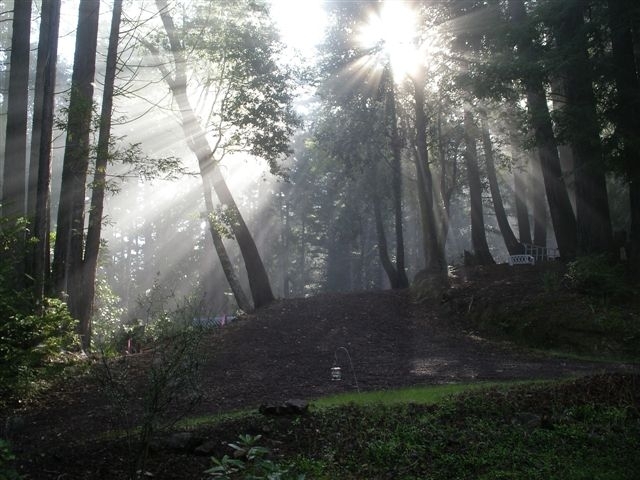

 Forest Light in Mendocino, by Ronnie Holland.

The ridge-top property was severely overgrown and a fire hazard, so we’ve definitely been physically active making that better, cutting trails, and designing/ building a cozy all-weather cabin, several garden areas, a generator/battery house, and most recently a small barn.


 The barn “before.”

We have a well, are adding additional water storage for fire protection, want to install a solar system when we can afford to, and keep enjoying the property now, while planning potential retirement options for later.

Dare I ask “what’s next” for Ronnie?  I won’t even try to keep up with you!  I gave that up a LONG time ago!!

I like to periodically run myself through two tests:

1)    Ten Faces of Innovation (by Tom Kelley of IDEO): Besides my favorite roles of collaborator, cross-pollinator, set designer, and storyteller, which of the ten roles needs a refresh?
2)    Live Life Backwards: If there’s something I want to do by a particular age, what must I do now to get there?  Reviewing each decade of one’s life, what one learned, and the surprises is both fun and revealing!

Besides continuous learning and  keeping home , hearth and friends together, I see a tremendous need for all of us to share our expertise now, no matter what type or level of skill, with the next generation taking over as the Baby Boomers retire. With the loss of many basic industries overseas and increasing costs of higher education, our entire society and quality of life is already or will be affected by the knowledge loss. Tapan Munroe writes about this problem in his columns, and in a recent book (www.ClosingAmericasjobgap.com). Every possible route to transfer knowledge can be explored: whether it is classes, workshops, conferences, articles, website content, online training and certification, creative arts, incubators, retreats, friendships – as long as we get there. I think this challenge will keep us all doing satisfying work for a long time!

So, in the meantime, LinkedIn is a good place to see periodic snapshots of what’s happening with me: http://www.linkedin.com/in/ronnieholland.

I know readers will want to read your poems.  Also, we have many readers who are also passionate about your current professional venture in energy resources with U.C. Davis.  How can readers reach out to you for more information, and how can we buy copies of your book of poems?

For all of the above, they can email me at ronnie.holland.rr@gmail.com, or visit the Cal-IRES site (see Resources tab for links to other organizations). For more about Lily’s art visit:  http://www.livermoreartassociation.org/onlinegallery/LilyXu/LilyXu.html.


  The barn “after.”

So, great readers, I hope you have enjoyed Ronnie’s words and thoughts and know why so many of us find her to be incomparable.  And trust me --- she’s sincere in her offer to chat with you on-line or perhaps in-person.  She’s interested in EVERYTHING,  truly, and is a great ambassador of people and our notions, imaginations and visions for a better world.  So don’t be surprised when you reach out to her if she also puts you in touch with others with similar interests. 

Where will Ronnie take us next?  I don’t know, but I can’t wait to find out --- and I’m sure we’ll be blogging about her again!

So, as a final note, to both thank and honor Ronnie, here is my Haiku to her:
 

Sprite-like, strong and smart, 

student, teacher, leader.  Most, 

a gift to us all.

Monday, June 27, 2011

Ted and Janie's Excellent Adventure!

If I’m ever invited on a show where they ask me which two people I’d like to have with me if I’m stranded on a desert island, I’m going to name Ted Hindes and Janie Hodges!  Chances are good that if they are there, we’re saved in a few hours.  And if not, it will be a better adventure than anything Daniel Defoe dreamed up in Swiss Family Robinson!

You may remember last year when I started our Blog that Carolyn Hindes, a pretty amazing woman in her own right, was our first featured client.  Now it’s time to meet her charismatic brother, Ted, and his true love, Dr. Janie (as she’s fondly called).  

Meeting Ted is like meeting the Pied Piper.  His unbridled optimism and enthusiasm for all things “life” are unparalleled and mischievously infectious.  If he says, for example, “Hey, let’s go to the South Pole tomorrow!” you are already mentally packing your bags and figuring out how you’ll get to the airport on time.  All of life’s other minutiae just kind of melts out of sight.  

Well, he met his match in Janie.  Because she’s not just mentally but actually physically packing the bags, but she’s also organizing the 1,600 other details that go into making it happen, including the passports, the shots, the proper gear and clothing not to mention the pet sitters, etc, etc.  

So when Ted told me a while ago that he and Janie were selling all their worldly goods, building their own sailing yacht, traveling around the world, and then settling in New Zealand permanently, I admit, I put up a pathetic verbal intellectual sparring match with all sorts of perfectly logical Jewish Mom/Certified Financial Planner sorts of concerns and objections --- but, yeah, you guessed it, I was out classed every step of the way!  Knowing when to retreat and lick my wounds, I comforted myself with the knowledge that this was going to make one heck of a great whale’s tale --- but time has passed and while the tale is ready for the telling, the story has definitely changed.  Keep reading for one great client story!  Enjoy!


 Ted and Janie enter the New Zealand town with the longest name in the world!

Ted, I met you while you were still an active professional pilot and shortly before a life changing medical event.  If you are willing, can you tell us about your life pre-cancer, the incredible fight you put up battling cancer, and how you think that shaped your attitude and vision for your future.

 
I moved away from the Bay Area in 1982 to attend prep school in New Hampshire.  While a student there, I worked in the school fire department and was the fire chief for 18 months.  I attended college at Oklahoma State University as a Fire Protection and Safety Engineering major.  In my third year of college, I was told by one of my instructors that I was going to fail calculus.  This would have caused me to go on to academic probation, bad on many levels, but especially not good because I was the captain of the sailing team!  So I switched my major to Aviation Science.  I had already gotten my commercial pilot rating by flying on nights and weekends.  This switch enabled me to drop calculus and also still graduate on time.

After graduation, I attended U.S. Coast Guard Officer Candidate School in Yorktown, VA.  I served four years on active duty and six years on reserve.  Then, in 1995, I joined the Drug Enforcement Administration as a special agent assigned to the Washington D.C. field office.  In 1999, I returned to flying as a civilian instructor pilot for the U.S. Air Force in San Antonio, TX. Later on, in 2000, I went to work for AirNet Express flying freight at night in a prop plane.  In 2002 I became a Learjet co-pilot.  After that I received my first type-rating in the Learjet 35 in 2003 and moved to Dallas and started hauling “self-loading cargo” (people!). In 2004, I transitioned to the Learjet 60.


 Ted and the Learjet 60

May of 2005 saw me suffering from chronic nasal congestion.  The physicians who saw me treated me for a sinus infection and also allergies, but after the second round of antibiotics with no improvement, I was sent for an MRI.  Within a week, I was diagnosed with sino-nasal undifferentiated carcinoma.  This necessitated a 12 month cessation in flying as I received chemotherapy and radiation.  Two weeks after my diagnosis, I started chemotherapy.  I did four rounds of chemotherapy over six months and also had 31 days of radiation.  My sister, Carolyn Hindes, came from San Francisco every other week during this period to take care of me.  After the first round of chemo, we had 28% shrinkage of the tumor.  Then there was a total of 35% shrinkage after the second round of chemotherapy.  I was very fortunate that I suffered only minimal side effects, negligible hair loss and did not require any days of hospitalization.  I learned during this time of my life that keeping up a good attitude and a smile not only helped those around me – both fellow patients and the treatment providers – but also helped lift my spirits on those days when my burden seemed a little heavy.  There are some after effects from the radiation.  I have lost most of my sense of smell and developed cataracts and radiation retinopathy in both eyes.  The retinopathy has caused temporary losses of vision at times.  I have had both cataracts removed and new lenses put in and I am currently being treated with laser and injections for my retinopathy.  In April of 2006, I had surgery to remove the tumor and found out I had indeed won my battle against this cancer.

I was happily returned to flying status in June, 2006.  In June of 2007, I received my third and final type rating in the Learjet 45.  On Halloween day in 2008, I got an email informing me that the company I worked for had gone out of business at 5:00 p.m. that day.  At this point I made the decision to stop flying and pursue other career opportunities.  After considering, then discarding a few different possible career choices, I started FR8Dog Photography. 


 Janie and the seagull posse at dinner.

Tell us about meeting Janie, and when you two figured out that you were meant to be together.

I first met Janie in 2003 when I moved to Dallas.  I brought my dog, Ebbitt, to her veterinary clinic for vaccinations.  I liked the way she and her staff interacted with Ebbitt, as well as me!  Over the years, we struck up a friendship and even bonded a little over a life-saving emergency surgery she performed on Ebbitt. In December of 2005, I noticed she was collecting various things to send in care packages to the troops in Iraq and Afghanistan.  Since I had friends down range, I wanted to do something to thank her for making such an effort on behalf of our troops.  I had purchased a package of hockey tickets earlier in the season and still had some games left.  Since I knew she was a hockey fan, I offered her a choice of the remaining games.  She picked a game in January, a little over a month away.  When I stopped by the clinic about a week before the game to confirm, it came up in conversation that we were both currently single.  I found out later that she considered not attending because she was worried it could be construed as a date.  While she often saw her clients socially outside the clinic, she did not “date” clients.  While neither of us considered the outing a date, there was an unexpected spark and both of us did consider it a date by the end of the evening.  I even got a good night kiss.  We have been together ever since. 


Janie and her Kiwi friend.
Janie, from your perspective, tell us a bit about your life journey before meeting Ted and how your life path brought you two together.
 
I was born and raised in Amarillo, TX.  I attended Texas A&M University on a National Merit scholarship and was accepted into veterinary school after only three years of undergraduate study.  I moved to the Dallas – Fort Worth area upon graduation and worked in a three doctor practice for six and one-half years before opening my own veterinary clinic, Valley View Pet Health Center, in Farmers Branch, TX.  In 13 years, I took it from a single doctor practice with only two employees to a three doctor practice with over 20 employees. 


Ted and Janie sailing Doubtful Sound.
Okay, so now let’s switch gears and talk about the fun stuff and why this Blog is titled TED AND JANIE’S EXCELLENT ADVENTURE!   One day --- I’ll never forget this --- I got that call from you, Ted, announcing that I should hold onto my chair because you had decided to build a ship (for a LOT of money I might add in my defense!), sail it around the world, and end up in New Zealand where you and Janie would be living from then on, including the idea of dual citizenship.  Describe to us your vision at that time --- why you wanted to build a ship, and why you wanted to reside in New Zealand?

There were many reasons we wanted to build a yacht and sail for two years before ending up in New Zealand.  Janie was ready to sell her clinic and possibly work a little less. I was ready to sit down from flying and we were not happy with the direction the country was moving in.  However, after my battle with cancer and with both of us having lost our mothers to cancer or related conditions, we realized that life is just too short.   We were looking for a life-changing adventure.  We wanted to live on a sailboat because of the measure of freedom it would bring.  Since our house would be portable, we could live almost anywhere.  We made a list of all the places we would like to visit on our sailing odyssey and then tried to decide where we might like to end up.  We considered several places in the U.S. and other parts of the world, but always found some reason why it would not do – i.e. too hot, too cold, state income tax, etc.  Eventually, we settled on New Zealand.  The country is beautiful, the climate is nice, there is lots of coastline on which to park a boat, the Kiwis (New Zealand citizens) are very friendly and forthright and at the time, it had a relatively stable economy.  We developed a three year exit strategy and put it in motion.  This included each of us making monthly contributions to a savings account to build a war chest for this project.  
 
So, as they say, life happens while we are busy making plans --- and stuff definitely happened!  The plans changed a bit, and morphed to the “simple” notion of moving to New Zealand and becoming residents there.  What caused that change in plans, and what were your newest plans at that point?

Then the collapse of the mortgage market and several banks happened.  With the economy and our net worth taking an unexpected dive, we decided it would be foolhardy to sink what would be a LOT of money into an asset like a cruising class sailboat that would depreciate considerably.  At that point, it was decided to skip the two year world sail and go straight to New Zealand.
 
Ted and Janie, the planning and life changing events you experienced preparing for this move would daunt most of us.  Walk us through all the pre-planning of the practical steps you had to take to unwind your U.S. based life and existence.

With the advent of the internet, the world has become much smaller.  We did not have to worry about changing financial advisors, banks, etc., because so much could be accomplished online with Skype or even Voice over Internet Protocol (VoIP) phones such as Magic Jack.  We could still keep in touch with friends and family and also handle any business that might come up.  The hardest part of preparing for the move was deciding what to take halfway around the world with us, and what to give away, throw away or sell.  We became experts at putting each of our possessions through that decision-making matrix.  It was surprisingly hard to part with many things that we did not use, but that each of us had been dragging around with us for years.  Also in the process, Janie got to be very good at selling things on eBay and Ted helped with several things on Craig’s List.  In addition, we had participated in a community garage sale and then a year later had a big garage sale with two other families.  We already had Skype, but also purchased a VoIP phone.  In addition, we opened a bank account in New Zealand and transferred money for a vehicle and living expenses for four months.


200 pounds of luggage and three carry-ons – and that was just Janie’s stuff!

What was your vision of what awaited you in your new life as New Zealanders?  Where did you intend to settle?  What were your work plans and what were the requirements in New Zealand for American citizens to be allowed to live and work there?

Our plan was to spend four months living in four different areas on the North Island.  We planned to “interview” each area for three weeks then decide which one we liked the best.  Then we were going to use our last month to find more permanent housing there and hopefully jobs.  We then planned to return to the U.S. for a month to six weeks to finish packing up the house, having a final garage sale and either renting out the house or putting it on the market depending on the economy.  We were very fortunate to catch a good friend of the family between residences and he agreed to housesit for us for the four months as well as care for our cat, Sweet Cheeks.  The cat had his blood drawn for rabies titer testing and he would be able to go to New Zealand with us once his six month waiting period was over.

We were not too worried about finding work or getting visas.  New Zealand offers a skilled migrant track for immigrants with skills that are in short supply in the country.  Veterinarians are on the skilled migrant list.  (Pilots were also on the list until 2010).  With a Skilled Migrant visa, Janie and a domestic partner could live and work in New Zealand without going through too much red tape.  At this point, Ted was already planning on starting his photography business and so could concentrate on getting that up and running.  Janie did actually spend the day at a veterinary clinic in the Hawke’s Bay area after meeting the owner at a local winery.  With the exception of a few drugs that are not yet approved in the U.S. and the Kiwis’ charmingly accented English, the clinic was very similar to those here in the United States.  They offered Janie a job at the end of the day.  

So, we said a fond farewell to you in January as you two headed for a totally different part of the globe.   Tell us about arriving in New Zealand, the time you spent there, and how and why your plans changed.

We arrived in New Zealand after a “short” 13 hour flight from San Francisco.  We had already picked out a wonderful vehicle on the internet, a 2011 Land Rover Defender.  The salesman from the dealership picked us up at the airport and drove us to Hamilton (about one and one-half hours away) so we could complete the purchase of the vehicle.  We then went to a local branch of our bank and got EFPOS (similar to debit) cards.  This enabled us to pay for food, lodging, etc. in New Zealand dollars rather than use our credit cards and pay a foreign transaction fee on each purchase.  And finally, we checked into a local hotel.  That first day was quite long, but very productive.


 Ted and the Beast!

We had reserved a self contained (furnished with a kitchenette) apartment in the Wellington area for our first three week stay.  We wanted to live more like locals and cook for ourselves, etc. to closer approximate what we would do if living there permanently.  We immediately noticed that food prices were much higher than we expected.   In fact, in many cases, they were almost double what we pay in Texas.  We expected gas and housing prices to be more expensive than here in the U.S. but the food prices really surprised us as they were not that high when we visited New Zealand in 2009.   We hoped that this was just confined to the Wellington area since it is New Zealand’s capital, but we found when we relocated to the Hawke’s Bay area three weeks later that food was just as expensive there.  In addition, after talking with several people we found out that while food prices had risen dramatically over the last 18-24 months in New Zealand, wages had remained stagnant for about four years.  Janie found out that she would have to work more days each week and take emergency call several nights each month to barely make the same amount of money she was making here in the U.S. with no night duty and working only four days a week.


 Janie, “Kiwi,” and Ted hiking in the rain forest.

The country was just as beautiful as we had remembered it and the people were just as wonderful, but we soon realized that our dream of moving to New Zealand and having a better, slower-paced lifestyle and possibly some land with a few cows and sheep was just not going to be financially feasible.  Instead, we could very easily see our lifestyle changing for the worse as we became cash poor and struggled to make ends meet while trying to start this new life.  

What was the best part of these past six months?  What did you learn about yourselves?  And would you do it all again --- and if so, what would you change?

There were several best parts about the past six months.  The first best part was making a point to reconnect with friends and family before we went so far away.  We went on something of a “farewell tour” to various parts of the United States for the specific purpose of visiting all of our friends and family that do not live locally and that we had not seen in quite some time.  

The next best part was the excitement of the realization that, “Wow!  We are really doing this!  All the hard work and saving and planning is coming to fruition.”

Believe it or not, one of the best parts was the vehicle we purchased in New Zealand.  The Land Rover Defender has been around forever.  It is claimed that it was the first car seen by 60% of the world’s developing population.  They do not export them to the U.S. because they do not have any of the required safety features such as air bags, safety bumpers, etc.  We adored that vehicle and affectionately nicknamed it “The Beast.”  It carried us many places most other vehicles could not go such as across beaches as the tide was coming in and along primitive cliff-side roads.  We also gathered many appreciative stares while going through town.  When we decided to leave New Zealand, we investigated bringing it back to the U.S. with us.  However, because of the lack of required U.S. equipment, we were not allowed to bring it into this country.  We miss you Beastie! 


 Ted preparing for a hike and photo shoot.

The last best part of the last six months was the 32 days we spent on the Queen Mary 2.  After we made the very difficult decision to not immigrate to New Zealand, we decided to use the money we had saved to move all of our household goods to New Zealand, for a vacation instead.  We were not sure we would have the money or the time off again for a long while.  We found a great deal on the last 32 days of the Queen Mary 2 World Voyage for 2011.  We joined the ship in Singapore and then visited Thailand, India, Dubai, Egypt, transited the Suez Canal, Italy, Monaco, Spain and England before disembarking in New York City.  We enjoyed our balcony room with breakfast delivered each morning, all the great activities on board and, of course, each of the countries we visited.  


 Ted’s birthday aboard the QM2. 


The most important thing we learned (or at least reaffirmed) about ourselves is that we can make the hard decisions when we have to.  We planned this adventure for 38 months and then six weeks in, we find out it was just not what we were hoping for.  We could have dug in and gotten stubborn and put ourselves through a lot of anxiety and misery.  Instead, we had the courage to admit that things in New Zealand were not as we had planned and we needed to change our plan.  We avoided the trap of trying to lay blame and we came out of the experience on the other end with much confidence in ourselves and our decision-making abilities.  

As far as would we do it again, HELL YES!  Obviously, we lost money having to sell our wonderful vehicle so soon after we had bought it, but even that decision we would not change because having The Beast carry us around to all of our New Zealand adventures brought some intangibles with it that money can’t replace.  
 
So, what’s next for our true globe trotters?

We are going to stay put at least for a little while as we figure the next part out.  We do not think we want to stay in a place that gets so hot in the summer and would love to be on the water somehow.  We are thinking about how to incorporate sustainable living at our next place with growing some of our own food and not being quite so connected to the urban hustle and bustle.  To that end, we are working on increasing our financial freedom by trying to increase our passive income.  Ballou Plum will be a significant partner in helping us achieve this.  Travel will still be a huge part of our lives as our recent adventures have really only whet our appetites for more.  By using home swap programs and/or staying in self-contained rentals, we plan to decrease our travelling expenses allowing us to spend more time in each area we visit.  
 
Ted, tell us about your new photography venture, and where can readers follow your work?

I am doing travel, portrait and event photography.  You can see my work at www.FR8DogPhoto.com or to buy images go to www.SmugMug.com and search for FR8DogPhoto.  You can also follow FR8DogPhoto on Twitter and “like” us on Facebook.


 Photo taken and postcard created by Ted for Awatea Lodge.

I’m sure readers are going to want to talk to you.  If that’s okay, please indicate how they can reach you.

Ted: Ted@FR8DogPhoto.com
Janie: DrJanie@me.com

So, readers, if you are inspired by Ted and Janie to embark on your own excellent adventure, I know they’d love to hear from you as you make plans.  And who knows, maybe they’ll join you!  In fact, if we can talk them into running their own tours, I’d say “look out Rick Steves!”  

Be well, have fun, and follow your passions, too!

Wednesday, May 25, 2011

Ann Kositsky ---- Founder of AMK Creative Care Management

It’s such a pleasure to feature valued long-time client, Ann Kositsky, this month. Ann and I have known each other since the days when her children were quite little and I was more focused on the tax side of my professional life than the wealth management practice. We’ve watched not only our children, but each other, grow and change, and often remark that it’s so fascinating how family shapes not only our personal lives, but our professional journey as well.

As you read about Ann’s new business, AMK Creative Care Management, what will strike you is how that journey can often lead us to just the right place at just the right time. I can’t think of a more timely business to start right now than a Care Management firm. As the parents of the baby boomers age --- not to mention the baby boomers themselves --- finding good solutions at life’s very challenging juncture of aging is becoming a main focus in households around the world.

I hope you will enjoy Ann’s voice as she shares with us her personal and professional path.


Ann Kositsky

Ann, I first met you when you were a mother to very young children. You were quite inspirational to me because not only were you raising children while caring for elderly parents, but you in fact were home schooling them, and quite brilliantly, I must say! Thanks to your advice, I spent many happy days at the Tilden Farm with my kids. Please share with us your decision to home school, how it was formed, what resources you used, and how you crafted such a successful education for your sons.

Home schooling was not part of my education plan for my kids until we started looking at schools for my oldest child, Aaron. He was really not ready to go onto school without his family and I couldn’t find any school to support this. In addition, my mother was one of the master teachers in Berkeley, and I would listen to her and her compatriots talk about how frustrated they were in the classroom. These were the best teachers, and they were so unhappy. I did not feel that I could subject my son to this. So we decided to home school. I had read books by John Holt on education and agreed with him that people learn best at their own pace and in their own unique ways. So we started. I found a support group for the kids and me to meet other families. Some of these people have remained close friends 20 years later.


I basically followed and supported my children’s interests. We incorporated the skills needed to support those interests. For example, Aaron was very interested in animals. The Tilden Little Farm was in our backyard, and though they never had volunteers before, the director and farmer supported our request that we volunteer as a family. When Aaron was five years old, our family volunteered weekly working at the farm. This led to studying about animal husbandry, breeding, creating and keeping charts on growth. In order to do these things, it required skills such as math and reading. These skills made sense to Aaron. When Joshua was four years old, he wanted to join the activity—so he did. The boys worked hard, they were able to assist in the birth of goats, talk with the public about the animals, care for and work with many different animals. They did this for nine years.


Aaron and friends at Tilden Little Farm

When the boys became interested in birds, and we went to some classes on raptors, this lead to an 18 year volunteer participation in the Golden Gate Raptor Observatory. This scientific project monitors the migration of raptors over the Pacific Fly Way. To understand what was being done there, the boys needed to learn statistics; and in order to learn that, they needed to learn math and computer programming! We were on a team of other bird watchers, so they had an opportunity to work with others of all ages as equals. The public would come to visit and birdwatch. The boys learned to talk to strangers and share their passion. Over time, each boy became leader of a team. They participated in helping develop policies to improve team function. Aaron became an intern for a season.

Their interest in knights led to participating in the Society for Creative Anachronisms and then to studying history, economics of the time periods, learning blacksmithing and building armor and more. This led to lots of reading, planning, meeting people and discussions. Going to the grocery store was always an adventure, each kid would be given a list of products to find and to figure out the cost and best quality. Thus their learning was based on their interests and needs.

This sounds crazy, but we watched “Star Trek, the Next Generation” very regularly. This became a major part of our core curriculum. There is so much material that is presented: ethics, philosophy, physics, medicine, literature, history and other sciences. After watching a program, we would discuss the material and end up by reading myths, Shakespeare, talking with various experts and so much more.


Aaron, Joshua and friend waiting to be beamed aboard.

Aaron wanted to learn Latin, so I found a good program and the two of us learned it. Joshua wanted to learn Spanish and he and I worked on this. I can’t say I taught Aaron and Joshua, I can say that I learned with them and supported them in their pursuits. This type of learning continued until they decided to go off to community college. My goal was always to support and encourage learning and curiosity. As long as they were learning and enjoying it, I continued the path. The pace did not concern me. Since each person learns at their own pace, that is what was focused on and supported.

Tell us how Aaron and Joshua are doing now.  What are their dreams and pursuits?

Aaron is in a PhD program studying ornithology and Joshua has a business as a jeweler-designer and is also a Scottish highland dance teacher. Both of them have partners and are happy, creative, thinking people. They continue to be independent learners and problem solvers. They continue to study and participate in historical reenactments.


Aaron and Joshua (and Ann in the background) at an historical reenactment.


What is your own educational background, Ann? How did your childhood influence your choices later in life?

I went to University to be an anthropologist. I decided early on that would not be my vocation. Instead I went into nursing. Since I have always been drawn to helping others, nursing fit me well. I continued on after my undergraduate degree was completed to earn a master’s in nursing and nurse practitioning. I also have many certificates in gerontology. I wanted to be available to help my parents and friends as they aged.
 

During the time I worked in the intensive care nursery, it was clear that there was no information for families going through these difficult times. I co-authored a book for parents struggling with the neonatal intensive care unit.

Though my focus was originally in neonatology and recently has shifted to gerontology, I have found there to be a lot of similarities.

Your parents were amazing and an incredible influence on your life. You were really there for them as they aged and came to depend on you. Tell us about your relationship with them, and why you decided to handle their care yourself. It was a lot to juggle while not only raising, but home schooling your young sons.

My parents were very involved in the first 13 years of my children's lives. I thought that it would be good for my parents to enjoy their grandkids, but I didn’t realize how meaningful it would be for my boys. I made an effort for the kids and grandparents to spend a lot of time with each other 3-5 times a week. My dad was an engineer and architect, so he would take them on building inspections and talk to them about the history of architecture. He also was handy at repairs, so he had them help him with projects around the house. Our home school community also embraced my parents--so they were very much part of our lives. My parents had lots of opportunities to share their values and beliefs with the grandkids—and that has stayed with them.

The kids were around and involved as my parents aged and died. This is sad—but allowed for both kids to see how to be part of an aging life. We also live in the house that my father designed and built. I am very lucky, I grew up in the house and my kids did as well.


Ann’s Dad and Mom.

After your sons came to depend on you less and less, you seemed to really come into your own and found that you actually had a passion and huge talent for Care Management! Walk us through that “ah ha!” moment, and what path you took to pursue this new-found career that you love so much.

Over the last 15 years, I have been caring for various family members as they declined. I found this so very interesting that I got further training in geriatrics and Care Management. I worked for another company and decided that working on my own would be more satisfying.

You recently launched your own Care Management Company, AMK Creative Care Management. Your educational background on top of the care you provided for your folks, all seem to have led you to this perfect moment in life. Tell us about your vision for your company and how you define “Care Management.”

My goal is to support people to live as independently as possible with whatever support they need. As a Care Manager, I work closely with the elderly, caregiver(s) and/or other family members to fully understand the needs and desires of each party. I function as an independent and knowledgeable partner who will provide objective guidance on how best to care for the elder in need. Although my primary goal is to do what is best for the elder, I also understand the importance of supporting the caregiver who will likely implement the care plan. As such, my caregiver plans will include specific caregiver support and guidance to ensure they can care for their elder while maintaining appropriate energy and balance in their own lives. I strive to serve not only the elder, but also those caregivers who love and care for them.

It’s incredible to me how much is involved in Care Management. Tell us about some of the issues that you assist with and take responsibility for.

I coordinate community and medical care. I often accompany the client to doctor visits and act as their advocate. I review medications and discuss tests and the client’s condition with the medical care provider. Often the doctor contacts me to follow-up on necessary recommendations and care.

It will vary from elder to elder, but here’s just a partial list of what’s involved in my field of work and some of the services I provide:

  • Provide geriatric assessment as an initial assessment of an individual's physical, mental, financial, and social needs. Creating a "Customized Plan of Care," including long-term care.
  • Create personalized care plan based on individual need, preferences and situation that is free of family dynamics and bias and then provide consulting and long-term care planning.
  • Provide assistance maneuvering through the healthcare system including assisting with Medicaid, Medicare, and Veteran Benefits planning and application and maximize the benefits and coverage of health insurance plans.
  • Assist with domestic, legal, and financial service coordination and provide basic day to day fiscal management such as bookkeeping and monthly bill paying.
  • Speak with the elder's medical providers to enhance understanding of elder care plans and to communicate concerns and then help elder and family to understand and assist in implementing a doctor’s treatment plan. Also creating and implementing a plan to facilitate safe medicine taking, scheduling and refilling as well as providing education about safe use of medications.
  • Assist in scheduling of appointments with primary care doctors, specialists and other providers of care for the elderly and arrange for senior transportation to medical appointments.
  • Evaluate the home safety environment to maximize the independence of the elder while minimizing safety risks and make recommendations to decrease the risk of injury for the elderly.
  • Help address concerns about the elder’s ability to drive and suggest alternative transportation options.
  • Determine the need for home health aides, homemakers and companions and advise on how best to obtain elder care providers of these services.
  • Guide and support family and elder in the evaluation and selection of the following types of alternative living options: assisted living, skilled nursing care, long-term care rehabilitation settings, adult day care, respite care, and make on-site visits to ensure that elder is receiving the best care possible.
As the baby boomers and our parents age, Care Management seems to be one of the most discussed topics in our practice as we work with our clients. What do you think are the unique challenges that we face as we age?

Learning to age gracefully is an important challenge. Our society does not support the elderly in society. We are not so used to being multi-generational families. We will all need to learn how to honor the elderly while at the same time providing care for them. Many people will develop dementia and need support as they age. Just looking at the partial list of things that I provide as a Caregiver can give you an idea of the tremendous amount of issues that can be involved for just one person.

Your approach is so hands on, Ann, and you look at things from a perspective of not only compassion, but also practicality. One such example is “Go Wish” which you introduced to me recently, and which I think is a phenomenal tool for families to use. Tell us about how this actually helped in your own family, and how important these, and other tools are in launching and facilitating what can be very tough conversations. How involved are you, as a Care Manager, in facilitating these moments in your clients’ and families’ lives?

Go Wish is a set of cards with value statements. The idea is that you identify what is important to you at the end of your life and communicate these values to significant others who will be making decisions on your behalf by prioritizing the statements on the cards.

Recently, I had surgery and before the event, I used the cards to start the discussion of what is important for me with my two boys. We each went through the cards and each of them prioritized the cards as they thought I would do. Then we compared our rankings. Though basically we were in agreement, there were some significant areas that we were able to talk about. This process led to my kids doing this for each other. I was really touched by how helpful these cards were. Talking about death is hard and asking questions like “what do you want?” can be too open ended. Having these cards as a springboard for thought and direction was so helpful. I use the cards with my clients and their families and keep a record of their responses. This is revisited as needed.

I continually look for ways to enhance my clients' lives. This means finding a folkdance teacher for one client, a Russian tea house for another so she can practice her Russian in a setting that she felt comfortable, or for others, it means getting a handyman to fix up the house to make it safer. One client would take her dog for long walks—and she was at risk for getting confused and then lost. The police found her one day and expressed their concern to the family for her safety. The client wants to stay in her own home. I found a small GPS that we placed on the dog’s leash. Now the client is safer and the family and police are not worried! Also as a side note, when the family wants to find their mother to take her to an appointment, they can easily locate her!

I am always looking to support my clients' wishes and desires. I will give my thoughts and advice whenever helpful. I support my client even if it is not the way I would do it—that is not the plan. It’s about supporting them.

Ann, do you have any seminars planned or community outreach events?

I offer blood pressure screening, Go Wish Seminars and support groups to those with aging parents. I will do an initial free one hour phone consultation with interested people.

How can Blog readers learn more about you and contact you?

I can be reached at annkositsky@gmail.com or by phone: 510/410-1984. You can also visit me on Facebook: www.facebook.com/amkccm.

So, from “Super Mom” to Care Management --- maybe not such a big leap after all, but a logical progression in Ann’s very inspiring life journey. Any of you needing Ann’s loving, well educated and thoughtful approach with family members will be in good hands.

Ann, thank you so much for sharing your journey with us and inspiring us to be brave about continuing to redefine ourselves and our passions --- both personal as well as professional --- as we evolve. You set a great example for us all to embrace life’s many changes.

Joshua and Aaron on their own journey…